
HP Pagewide Head Error Code
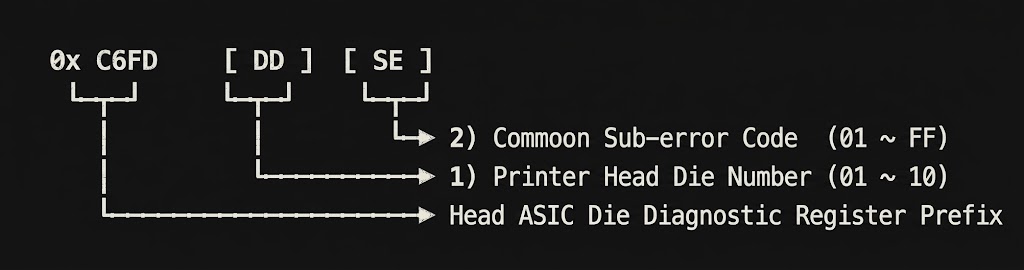
1. Die Number Area ( DD : 2 digits)
- Specifies the physical/logical location of the silicon die patch that makes up the head.
- 01 ~ 10 (or 01 ~ 0A in hexadecimal notation ): Each area from die 1 to die 10 is individually mapped 1:1.
2. Sub-suberror area ( SE : 2 digits)
- This area is the key. The last two digits of the code ( SE ) are a Common Bitmask that signifies the same physical and electrical phenomena across all dies, regardless of whether the die number is 01 , 05 , or 10 .
- Common Sub-Suberror ( SE ) Master Specification
- Regardless of which die number ( DD ) is received, the cause of the physical failure in the corresponding area can be immediately identified by checking only the last two digits of the sub-error ( SE ).
① Electrical and Data Interface System ( 01 ~ 06 )
|
subcode |
Engineering causes |
Physical state and signal state |
|
01 |
Open / Short |
Power/signal line open circuit or short circuit (FFC cable contact failure) |
|
02 |
VDD Low Resistance |
Sudden drop in internal logic power line resistance (circuit short due to cleaning fluid/ink penetration) |
|
03 |
High Impedance |
Increase in nozzle heating element (Heater FET) impedance (resistor degradation due to accumulation of air gradient) |
|
04 |
Serial Data Failure |
Serial Data (SDATA) Communication Waveform Distortion and Noise Interference |
|
05 |
Clock / Latch Sync Fail |
Clock ( CLK ) and Latch signal timing synchronization failure |
|
06 |
VPP Out of Range |
Nozzle driving voltage ( V PP) ( Approx. 24V–32V) deviation from error range (±5%) |
② Thermal and Fluid (Ink) Detection System ( 10 ~ 14 )
|
subcode |
Engineering causes |
Physical state and signal state |
|
10 |
Thermistor Fault |
Die internal temperature sensor (Thermistor) circuit open/short circuit malfunction |
|
11 |
Thermal Transient Error |
Temperature overshoot per unit time >Threshold) |
|
12 |
Thermal Warning High |
Warning: Abnormal temperate (160 °C ~ 180 °C ) → Throttling intervention |
|
13 |
Critical Thermal Trip |
Breakdown temperature exceeded (≥200 °C) → Forced hardware shutdown |
|
14 |
Dry Fire / Ink Depletion |
Detection of ink depletion and air ingress in the chamber (Thermo-hydraulic algorithm) |
③ Logic Damage and Irrecoverable System ( 20 , FF )
|
subcode |
Engineering causes |
Physical state and signal state |
|
20 |
Logic Gate Damage |
Internal logic gate failure (electrostatic / ESD and over voltage surge strikes) |
|
FF |
Unrecoverable Fault |
Silicon wafer die determined to be permanently damaged (irrecoverable, head replacement) |
The reason the HP firmware design team adopted this structure
- The reason HP R&D modularized error codes in this way is due to the efficiency of the firmware algorithm
- HP Internal Firmware Example (Conceptual Code) uint8_t die_number = (error_code & 0x0000FF00 ) >> 8 ; // middle 2 digits uint8_t sub_error = (error_code & 0x000000FF ); // last 2 digits if (sub_error == 0x13 ) { Trigger_Thermal_Shutdown(die_number); // Disable power interrupt for the corresponding die }
- The main controller (ASIC) can cut off power by instantly determining "which section (die) and what problem (Sub-Error) occurred" in nanoseconds (ns) through bitwise operations (AND Masking), without the need to individually define every error code.
Examples of Practical Field Application of Korean Infinite Printers (CISS)
Now, you do not necessarily have to memorize individual error codes; you can diagnose them immediately on-site simply by splitting the last four digits of 0xC6FD in half.
- 0xC6FD0513 → 05 (Die 5) + 13 (Thermal Trip) ⇒ "Ink did not pass to Die 5 area, so tempurature is over 200 °C
"It shut down due to overheating above 200 °C" (Cartridge air suction needed)
- 0xC6FD0814 → 08 (Die 8) + 14 (Dry Fire) ⇒ "Die 8 is filled with air!" (Check for feeder tube kinks or damper O-ring leaks)
- 0xC6FD0101 → 01 (Die 1) + 01 (Open/Short) ⇒ "Ink mist is on the FFC cable contact on Die 1 or the pattern is burned!" (Clean contacts with IPA)
Since you have a precise understanding of the principles, you will be able to control the hardware status much more precisely during future on-site repairs or data analysis.
Add Comment